
By Sam Pickren Air & Heating | St. Marys, Georgia
Could one small thermostat setting be adding unnecessary costs to your electric bill?
Most homeowners know how to adjust their thermostat's temperature, but there's another setting that often gets overlooked: the fan control.
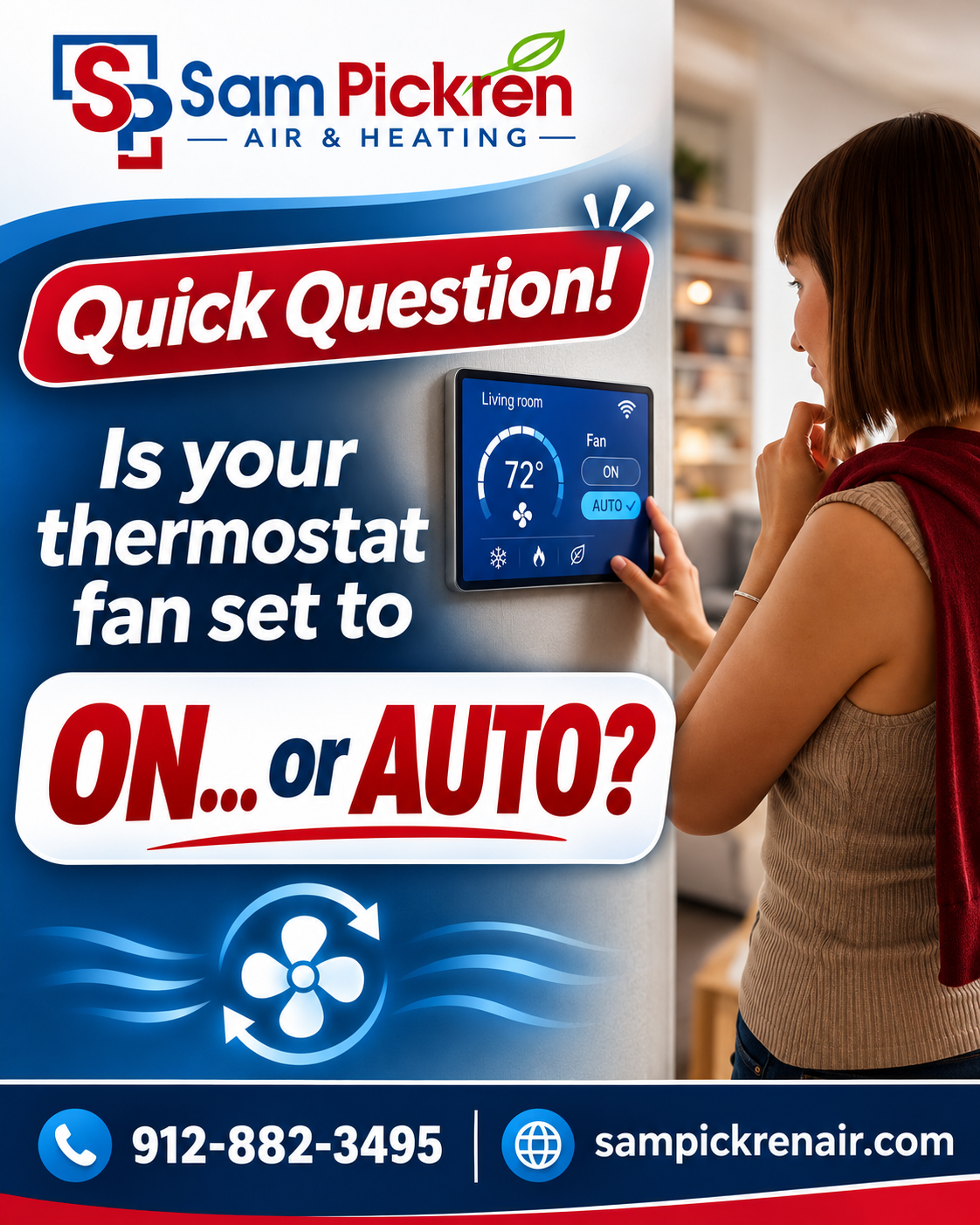
Look at your thermostat. Is the fan set to ON or AUTO?
That simple choice can affect your home's energy consumption, indoor humidity, and overall comfort.
And here in Southeast Georgia, where hot summers and high humidity are practically part of everyday life, choosing the right setting matters.
Should Your Thermostat Fan Be Set to ON or AUTO?
Quick Answer: For most homes, AUTO is the better setting.
When your thermostat fan is set to AUTO, the blower operates when your heating or cooling system needs to circulate conditioned air. When that cycle finishes, the fan typically turns off.
When set to ON, the blower runs continuously, even when your system isn't actively heating or cooling.
For most Southeast Georgia homeowners, AUTO offers three important advantages:
Lower electricity consumption: The blower isn't using electricity around the clock.
Better humidity management: During cooling season, AUTO can help prevent moisture from being returned to your home's air.
Efficient everyday operation: Air circulates when the heating or cooling system calls for it.
However, there are situations where continuous fan operation can be useful.
Let's look at both settings.
What Happens When Your Thermostat Fan Is Set to ON?
Setting your thermostat fan to ON means your HVAC system's indoor blower continues circulating air throughout your home.
This doesn't necessarily mean your air conditioner or heat pump is constantly cooling or heating. It means the blower keeps operating between heating and cooling cycles.
Advantages of the ON Setting
Continuous circulation may help:
Distribute air more evenly throughout your home.
Reduce temperature differences between rooms.
Move air more frequently through your HVAC filter.
These benefits can be helpful in homes with airflow or temperature-balancing concerns.
Disadvantages of Leaving the Fan ON
Continuous operation also has drawbacks.
Higher electricity consumption: Your blower motor uses electricity while operating. Keeping it running continuously can increase operating costs, although the amount depends on your equipment and motor type.
Potential humidity problems: During air conditioning season, moisture collects on your system's cooling coil. When cooling stops but the fan keeps running, some of that moisture can evaporate back into the circulating air.
More blower operating hours: Continuous operation increases fan runtime, which also affects filter maintenance needs.
For Southeast Georgia homeowners, humidity is one of the biggest reasons to think carefully before choosing ON.
Why AUTO Is Usually Better for Southeast Georgia's Humidity

If you've lived in St. Marys, Kingsland, Woodbine, or anywhere along the Southeast Georgia coast, you know our summers can get seriously humid.
Your air conditioner does more than cool the air. It also removes moisture as warm indoor air passes over the cold evaporator coil.
That moisture drains away through the system's condensate line.
But here's something many homeowners don't realize.
If your blower continues running after the cooling cycle ends, some moisture remaining on the coil can evaporate back into your home.
This may make your home feel more humid, even though your air conditioner has been running.
The University of Georgia Cooperative Extension recommends using a properly maintained, correctly sized air conditioner with the fan set to AUTO as one way to manage household moisture.
That's particularly relevant for homeowners in our coastal climate.
According to the U.S. Environmental Protection Agency, indoor relative humidity should generally remain below 60%, ideally between 30% and 50%, when practical.
Source: University of Georgia Cooperative Extension — Preventing Mold in Your Home
Source: U.S. Environmental Protection Agency — Mold and Indoor Humidity
Can Switching Your Thermostat Fan to AUTO Lower Your Electric Bill?
Yes, switching from continuous fan operation to AUTO can reduce blower electricity consumption.
Here's why.
When the fan is set to ON, the blower may run 24 hours a day.
With AUTO, the blower runs primarily during heating and cooling cycles.
That means fewer hours of electricity consumption from the blower motor.
However, your actual savings depend on several factors, including:
Your HVAC system's motor efficiency.
How frequently your heating and cooling system operates.
Your home's insulation and ductwork.
Your local electricity rates.
Your existing thermostat settings.
Modern variable-speed blowers can use significantly less electricity at low speeds than some older blower motors. Even so, running a fan continuously still consumes energy.
There isn't one universal dollar amount that every homeowner will save by choosing AUTO.
But for many homes, it's a simple setting worth reviewing.
What About Smart Thermostats and the CIRCULATE Setting?
Many smart thermostats offer a third option beyond ON and AUTO.
It's often called CIRCULATE, although the exact name depends on the thermostat manufacturer.
Instead of operating continuously, this setting runs the blower periodically throughout the day.
It may be useful for homeowners who want additional air circulation without leaving the fan running all the time.
However, in humid climates, periodic circulation can still affect moisture levels during cooling season.
If you're unsure which setting is best for your system, a qualified HVAC technician can help you choose an appropriate configuration.
How to Change Your Thermostat Fan Setting
For most standard thermostats, changing the fan setting is simple.
Locate the fan setting on your thermostat.
Look for options labeled ON, AUTO, or CIRCULATE.
Select AUTO for typical everyday operation.
If you have a smart thermostat, review its scheduling and fan circulation settings.
Some systems have specialized ventilation, humidity-control, or variable-speed configurations. Follow your equipment manufacturer's instructions, and avoid changing installer-level settings without professional guidance.
Frequently Asked Questions About Thermostat Fan Settings
Is it cheaper to leave the AC fan on AUTO or ON?
AUTO is generally cheaper because the indoor blower operates fewer hours. Exact savings depend on the blower motor, system runtime, and electricity rates.
Does leaving the AC fan ON make your house cooler?
Not necessarily. Continuous fan operation may help distribute air more evenly, but it doesn't make the air conditioner produce additional cooling. In humid conditions, it can sometimes make the home feel less comfortable.
Should I leave my thermostat fan on AUTO during winter?
For most homes, AUTO is also a good everyday choice during heating season. Continuous circulation may help balance room temperatures, but it uses additional electricity.
Does running the HVAC fan constantly improve air quality?
Continuous operation can move more air through the system's filter, but the actual filtration benefit depends on the filter, airflow, and system design. For many homes, a properly designed filtration or ventilation strategy is more effective than simply leaving the blower running all day.
Should I use AUTO if I have a heat pump?
In most conventional residential heat pump systems, AUTO is a reasonable starting point. However, some heat pumps have specialized blower controls or humidity-management features, so follow the manufacturer's recommendations.
Can the wrong thermostat fan setting increase humidity?
Yes. During cooling season, continuous blower operation can allow moisture on the cooling coil to evaporate back into the home's air. This is particularly important in humid climates like Southeast Georgia.
The Bottom Line: AUTO Is Usually the Smarter Choice
Here's the takeaway.
If your thermostat fan is set to ON, your blower may be running around the clock—even when your home doesn't need additional heating or cooling.
For most Southeast Georgia homeowners, switching to AUTO can help reduce unnecessary electricity consumption while supporting better humidity control.
It's a small adjustment that can make a meaningful difference in how efficiently your system operates.
And remember, even the best thermostat settings can't compensate for an HVAC system that isn't properly maintained.
Keep Your HVAC System Running Efficiently with Sam Pickren Air & Heating
At Sam Pickren Air & Heating, we've been helping homeowners in Camden County and the surrounding Southeast Georgia area stay comfortable for generations.
Whether you need help with thermostat settings, uneven temperatures, humidity concerns, or routine HVAC maintenance, our team is here to help.
Want to take better care of your system year-round?
Our Preferred Customer Service Agreement offers benefits including priority customer service, 10% off parts and filters, lower hourly service rates, and routine preventive maintenance.
Call Sam Pickren Air & Heating at 912-882-3495 or learn more about our Preferred Customer Service Agreement.
Sam Pickren Air & Heating — Your Comfort Is Our Priority!
Serving St. Marys, Kingsland, Woodbine, Camden County, and surrounding communities in Southeast Georgia.
Educational sources
